
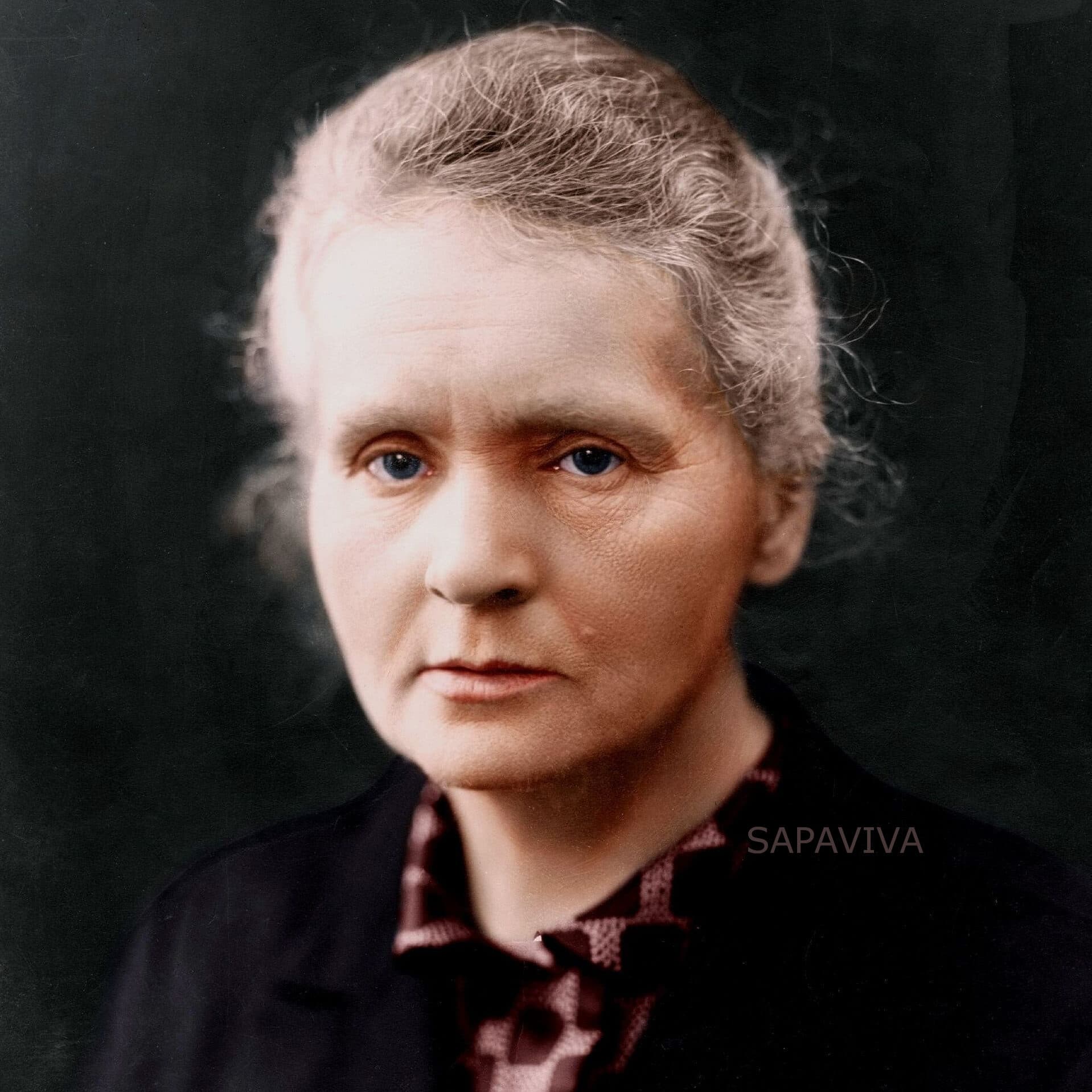
A story worth remembering.
Marie Curie was a pioneering physicist and chemist whose work transformed the understanding of radioactivity and helped open doors for women in science. Born in Warsaw and later working in Paris, she became the first woman to win a Nobel Prize and the first person to receive Nobel Prizes in two different scientific fields. Her discoveries of polonium and radium, her research into radiation and her wartime work with mobile X-ray units created a legacy that still influences science and medicine today.
Marie Curie’s life began far from the laboratories that would eventually make her one of the most recognised scientists in history. Born Maria Skłodowska in Warsaw in 1867, she grew up in a family that valued education. Poland was then under Russian control, and educational opportunities for women were severely restricted. Women could not simply follow the same university path available to men.
Curie eventually left Poland for Paris, where she studied physics and mathematics at the Sorbonne. The move gave her access to formal scientific education, but life was not easy. She lived modestly and worked intensely while establishing herself in a world where women were still rarely recognised as serious scientists. Nobel Prize Her scientific career changed dramatically after Henri Becquerel discovered radiation from uranium. Curie began investigating this strange phenomenon and developed a systematic way of measuring it.
Working with Pierre Curie, she found that the mineral pitchblende was far more radioactive than uranium alone could explain. Their research led them to identify two previously unknown elements. The first was polonium, which Marie named after Poland. The second was radium. Their discoveries helped establish the science of radioactivity and changed scientists’ understanding of the atom itself.
In 1903, Marie Curie shared the Nobel Prize in Physics with Pierre Curie and Henri Becquerel for their research into radiation phenomena. She became the first woman to receive a Nobel Prize. Her life changed again in 1906 when Pierre Curie died suddenly. Rather than abandoning their scientific work, Marie continued it and took over his teaching position at the Sorbonne, becoming the first woman to hold that professorship. Nobel Prize Her research continued to advance.
In 1911, she received the Nobel Prize in Chemistry for her work involving radium and polonium and for advancing the understanding of radioactive elements. This made Marie Curie the first person ever to receive two Nobel Prizes. She remains the only individual to have received Nobel Prizes in two different scientific categories. Nobel Prize But Curie’s contribution was not limited to laboratories and awards. During the First World War, she recognised that X-ray technology could help doctors locate bullets and injuries inside wounded soldiers before surgery. She helped develop and organise mobile radiography vehicles that could travel closer to the battlefield. These vehicles became known as the “petites Curies.” She also helped train people to operate the equipment and worked to expand the use of radiology in medical care during the war.
Curie believed scientific knowledge should be useful to society. Her work contributed to the development of radiation-based medical treatment and established foundations for future research in nuclear physics, chemistry and medicine. She also helped establish research institutions dedicated to radioactivity, including the Radium Institute in Paris. Her achievements are even more significant when placed in the context of the world in which she lived. Marie Curie entered scientific institutions when women faced significant barriers to higher education, academic appointments and recognition. Yet she became one of the most respected scientists of her generation. Her story is not simply about becoming the first woman to achieve something. It is about refusing to accept that knowledge, discovery or leadership belonged only to men. Marie Curie demonstrated that intellectual ability has no gender. And more than a century later, generations of women entering science, technology, medicine and research continue to walk through doors that women like Curie helped force open.